

Kế hoạch bài dạy Tiếng Anh Lớp 5 (Global Success) - Tuần 24 - Năm học 2024-2025 - Nguyễn Lê Vân Anh
 20 trang
05/04/2026
20
20 trang
05/04/2026
20
Bạn đang xem tài liệu "Kế hoạch bài dạy Tiếng Anh Lớp 5 (Global Success) - Tuần 24 - Năm học 2024-2025 - Nguyễn Lê Vân Anh", để tải tài liệu gốc về máy hãy click vào nút Download ở trên.
Tóm tắt nội dung tài liệu: Kế hoạch bài dạy Tiếng Anh Lớp 5 (Global Success) - Tuần 24 - Năm học 2024-2025 - Nguyễn Lê Vân Anh
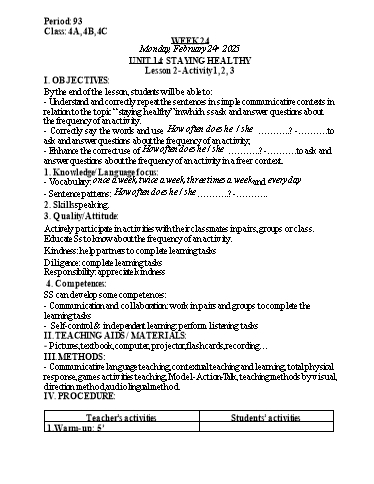
 Period: 93
Class: 4A, 4B, 4C
 WEEK 24
 Monday, February 24th 2025
 UNIT 14: STAYING HEALTHY
 Lesson 2- Activity 1, 2, 3
I. OBJECTIVES:
By the end of the lesson, students will be able to:
- Understand and correctly repeat the sentences in simple communicative contexts in
relation to the topic “staying healthy” in which ss ask and answer questions about
the frequency of an activity.
- Correctly say the words and use How often does he / she ..? - ..to
ask and answer questions about the frequency of an activity;
- Enhance the correct use of How often does he / she ..? - ..to ask and
answer questions about the frequency of an activity in a freer context.
1. Knowledge/ Language focus:
- Vocabulary: once a week, twice a week, three times a week and every day
- Sentence patterns: How often does he / she ..? - ..
2. Skills:speaking.
3. Quality /Attitude:
Actively participate in activities with their classmates in pairs, groups or class.
Educate Ss to know about the frequency of an activity.
Kindness: help partners to complete learning tasks
Diligence: complete learning tasks
Responsibility: appreciate kindness
 4. Competences:
SS can develop some competences:
- Communication and collaboration: work in pairs and groups to complete the
learning tasks
- Self-control & independent learning: perform listening tasks
II. TEACHING AIDS / MATERIALS:
- Pictures, textbook, computer, projector, flashcards, recording
III. METHODS:
- Communicative language teaching, contextual teaching and learning, total physical
response, games activities teaching, Model-Action-Talk, teaching methods by visual,
direction method, audiolingual method.
IV. PROCEDURE:
 Teacher’s activities Students’ activities
 1.Warm- up: 5’ Game: Slap the board
*Aims: to help ss to be happy to learn new
lesson.
*Teaching techniques
- techniques in teaching playing game.
*Procedure:
- Prepare pictures of different types of -Ss look and listen.
food and drinks.
- Divide the class into 3 teams. Number Ss
in each team.
- Focus Ss on the sentences and pictures on - Ss play game.
the screen.
- Call out a number and ask student to slap
the correct answer on the board.
- Check the answer with the whole class.
-Say “Open your book page 26 and look at -Ss open their book.
Unit 14, Lesson 2 – Activity 1, 2, 3”
2. New lesson
Activity 1. -1.Look, listen and repeat:9’
*Aims: To understand and correctly repeat
the sentences in two communicative
contexts (pictures) focusing on asking and
answering questions about the frequency
of an activity.
*Context:
- Context a: Ben and Mai at a swimming
pool talking about Mai’s brother
Ben: Your brother’s a strong swimmer.
Mai: Yes, he is. He wants to join the
swimming team at his school.
- Context b: Ben asking Mai about her
brother’s habit
Ben: That’s great! How often does he
swim?
Mai: Every day. Even at the weekend.
*Teaching techniques:
- techniques in teaching listening and
speaking,
- individual, pairworks, ask and answer
- using flashcards, recording, pictures
*Procedure:
-Set the scene: we are going to listen to the
dialogue in which the characters ask and -Look at the picture and listen. answer about the frequency of an activity.
- Ask students to look at the picture in the
book and identify the characters in the -Ss look at the picture and identify
pictures: the characters in the pictures.
+Who are they in the picture?
+What are they talking about?
- Play the recording again for Ss to listen
and repeat in chorus, sentence by sentence. -Ss listen and repeat sentence by
-Divide the class into two groups to read sentence.
the dialogue. -Ss read in groups.
-Have time for Ss to point and read in
pairs. T goes around the classroom to offer -Ss point and read in pairs.
support where necessary.
- Invite some pairs to practise in front of
the class. -Ss practise in front of the class.
- T get feedback.
*Outcome: Ss can understand and
correctly repeat the sentences in two
communicative contexts (pictures)focusing
on asking and answering questions about
the frequency of an activity.
 Activity 2 - 2. Listen, point and say:10’
*Aims: to correctly say the words and use
How often does he / she ..? -
 .. to ask and answer questions
about the frequency of an activity.
*Context:
- Picture and word cues:
a. a girl doing yoga and the phrases do
yoga / once a week
b. a boy playing badminton and the
phrases play badminton / twice a week
c. a boy drinking orange juice and the phrases drink orange juice / three times a
week
d. a girl eating vegetables and the phrases
eat vegetables / every day
- Speech bubbles: How often does he / she
 ..? - ..
*Teaching techniques
- techniques in teaching speaking,
pairworks, ask and answer
- using flashcards, recording, pictures
*Procedure:
- Teach vocabulary: once a week, twice a
week, three times a week and every day -Ss listen and repeat new words, then
(Using pictures) write on their notebook.
-Check vocabulary: game matching
- Have Ss look at pictures. Ask them to -Ss play game.
identify activity in each picture. -Look at the picture and answer.
- Sentence Pattern:
+ How often does he / she ..? -
 ..
-T models with a student. Then asks ss
practise in pairs. -A student model.
- Have time for Ss to practise in pairs and
corrects pronunciation if necessary. -Ss practise in pairs.
- Invite ss to ask and answer in front of the
class. (Play game: Who is faster?). -Ss practise in front of the class.
- T gets feedback
*Outcome: Ss can correctly say the words
and use How often does he / she ..?
- .. ask and answer questions about
the frequency of an activity.
Activity 3. Let’s talk :6’
*Aims: To use How does your . stay
healthy? – He / She ...and How often
does your ?
– He / She . to ask and answer questions about the frequency of an
activity in a freer context.
*Context: Picture cues: four pictures, each
containing a character, an activity and a
timetable.
– Speech bubbles: How does your .
stay healthy? – He / She ... and How
often does your ?
– He / She .
*Teaching techniques
- techniques in teaching speaking,
groupworks, ask and answer
- using flashcards, pictures
*Procedure:
-Tell Ss that they are going to practise
more with their friends to ask and answer
questions about the frequency of an -Ss look and listen.
activity in a freer context.
- Elicit the words to fill in the gaps and
have ss to repeat. -Ss repeat.
-Have time for ss to practise in pairs. Go
around the classroom to offer support -Ss practise in pairs.
where necessary.
- Call some pairs to act out in front of the
class.
- T corrects pronunciation, if necessary. -Ss act out in front of the class.
-T gets feedback.
*Outcome: Ss can use Do you live in ___?
– Yes, / No, ___. and What’s your address?
– It’s___. to ask and answer questions
about the frequency of an activity in a freer
context.
3. Consolidation :3’
*Aims: to consolidate and wrap up the
content of the lesson. - T tells Ss about the main content of the
 lesson.
 - T tells Ss about the educational aims of -Ss listen.
 the lessons.
 4. Homelink. 1’
 - Practice more at home.
 - Prepare for the next lesson.
 -Ss listen.
 ***********************************
Period: 94
Class: 4A, 4B, 4C
 Tuesday, February 25th 2025
 UNIT 14: STAYING HEALTHY
 Lesson 2 - Activity 4, 5, 6
I. OBJECTIVES:
By the end of the lesson, students will be able to:
-Listen to and understand a conversation in which the speakers talk about someone’s
healthy activities and circle the correct answers;
- Complete two gapped exchanges with the help of picture cues;
-Review the target vocabulary related to the topic “Staying healthy” by playing
Frequency Game.
1. Knowledge/ Language focus:
- Vocabulary: review
- Sentence patterns: review
2. Skills:
- Listening, reading and speaking
3. Quality /Attitude:
-Actively participate in activities with their classmates in pairs, groups or class.
Educate Ss to show their awareness of doing morning exercise regularly.
Kindness:help partners to complete learning tasks
 Diligence: complete learning tasks
Leadership: collaborate with teachers to enhance language skills
4. Competences:
SS can develop some competences:
- Communication and collaboration: work in pairs and groups to complete the
learning tasks
- Self-control & independent learning: perform listening tasks
II. TEACHING AIDS / MATERIALS:
- Pictures, textbook, computer, projector, flashcards, recording III. METHODS:
- Communicative language teaching, contextual teaching and learning, total physical
response, games activities teaching, Model-Action-Talk, teaching methods by visual,
direction method, audiolingual method.
IV. PROCEDURE:
 Teacher’s activities Students’ activities
 1.Warm- up: 5’
 - Game: Slap the board
 *Aims: to help ss to be happy and play
 game
 *Teaching techniques:
 - techniques in teaching playing game
 *Procedure:
 - Divide the class into two groups. Ask Ss
 to stand in two lines. - Ss listen.
 - Stick the cards (do morning exercise,
 play sports, drink fresh juice, eat healthy
 food, play football, do yoga, play
 badminton, drink orange juice, eat
 vegetables) on the board.
 - Call out a word and have the first student -Ss play game.
 from each group race to slap the correct
 card on the board and say it correctly.
 - The first student to slap the correct card
 wins a point for their group.
 - The group with the most points wins.
 Praise the winner.
 -Say “Open your book page 27 and look at
 lesson 2 – Activity 4, 5, 6” -Ss open their book.
 2. New lesson
 Activity 1. - 4. Listen and circle :9’
 *Aims: to listen to and understand two
 communicative contexts in which speakers
 ask and answer questions about the
 frequency of an activity and circle the
 correct pictures.
 *Context:Four questions, each with two
 answer options
 *Audio script:
 A: Hi, Mai. What’s Tony doing?
 B: He’s doing a project.
 A: What’s it about? B: It’s about staying healthy.
A: How does he stay healthy?
B: He eats healthy food like fish and
vegetables.
A: Does he drink lemonade every day?
B: No, he doesn’t. He drinks lemonade
twice a week.
A: Does he do morning exercise?
B: No, he doesn’t, but he plays basketball
three times a week.
A: Wow!
*Teaching techniques
- techniques in teaching listening
-individual, pairworks, using recording,
pictures
*Procedure:
-Draw student’s attention to the sentences
1and 2. Tell them about the activity. Elicit
the frequency of an activity in each -Look at the picture, listen and
picture. Point at the pictures respectively answer.
to explain the context.
- Play the recording for ss to do the task.
- Get Ss to swap with a partner. -Ss listen and do the task
-Play the recording again to check answers -Ss swap.
together as a class. -Ss listen and repeat.
-Ask ss to write their answers on the board
and correct their answers. -Ss write their answers
- T gets feedback.
* Key: 1. b 2. a 3. b 4. a
*Outcome: Ss can listen to and understand
two communicative contexts in which
speakers ask and answer questions about
the frequency of an activity and circle the
correct pictures. Activity 2 - 5. Read and complete:9’
*Aims: to read and complete two gapped
dialogues with the help of picture cues.
*Context: -Two picture cues
- Two gapped exchanges to complete
*Teaching techniques
- techniques in teaching reading
-individual, pairworks, pictures
*Procedure:
- Get Ss to look at the pictures. Get them
 -Look at the picture and identify.
to identify food, drink and activity in each
picture.
- Have Ss look at the four incomplete
sentences and guess the missing word.
Then draw Ss’ attention to the picture and
elicit missing word to fill in the gap
(orange juice)
- Model with a sentence.
- Have Ss complete the sentences -Ss do the task.
individually. Go around the classroom to
offer support where necessary.
-Ask ss to write their answers on the board
and correct their answers. -Ss write their answers
-Ask a few Ss to read the correct answers
in front of the class. -Ss read in front of the class.
-T gets feedback.
*Key: 1. orange juice; three times
2. How often; week; vegetables
*Outcome: Ss can read and complete two
gapped dialogues with the help of picture
cues.
Activity 3. - 6. Let’s play :7’
*Aims: to revise the target vocabulary and
structures related to the topic “Staying
healthy” by playing Frequency Game.
*Context: An illustration of two groups playing the game
– Five flash cards of healthy activities on
the board
– One pupil asks: How often does she do
aerobics?
– Another pupil holding up a '1' and
answering: Once a week.
*Teaching techniques
- techniques in playing game
- individual, groupworks, using recording,
pictures
*Procedure:
- Invite two teams, A and B, to play the
game. Tell the teams the rules, using the -Ss look and listen.
illustration as an example to demonstrate
how it works. Team A asks a question
using How often ...........? Team B then
picks a piece of paper with a number on it,
and uses the number to answer the
question. For example, the number one
means once a week or once a month. If the
question is asked correctly, Team A gets
one point. If the answer is correct, Team B
gets one point. If Team A fails to ask the
question correctly, Team A does not get a
point, and the teacher then asks the
question correctly to Team B so that they
can still earn a point. Then the teams swap
roles – Team B -Ss play game.
asks and Team A answers.
- After two minutes, the team with the
most points wins.
- The game continues with other teams.
*Outcome: Ss can revise the target
vocabulary and structures related to the
topic “Staying healthy” by playing
Frequency Game.
3. Consolidation :3’
*Aims: to consolidate and wrap up the
content of the lesson.
- T tells Ss about the main content of the
lesson.
-T tells Ss about the educational aims of -Ss listen. the lessons.
 4. Homelink .2’
 - Practice more at home.
 - Prepare for the next lesson.
 -Ss listen.
 ***********************************
Period: 95
Class: 4A, 4B, 4C
 Wednesday, February 26th 2025
 UNIT 14: STAYING HEALTHY
 Lesson 3- Activity 1, 2, 3
I. OBJECTIVES:
By the end of the lesson, students will be able to:
- Stress the correct words in Yes / No questions Does she 'eat 'healthy 'food? and Is
your 'brother a 'strong 'swimmer?;
- Identify and underline the missing stressed word in four questions, and to say the
questions with the correct sentence stress while listening;
- Say the chant with the correct pronunciation, word stress and rhythm.
1. Knowledge/ Language focus:
- Phonic: Does she 'eat 'healthy 'food? and Is your 'brother a 'strong 'swimmer?;
- Vocabulary: review
- Sentence patterns: review
2. Skills:
- Listening and speaking.
3. Quality /Attitude:
Actively participate in activities with their classmates in pairs, groups or class.
Educate Ss show their awareness of doing morning exercise regularly.
Kindness: help partners to complete learning tasks
Diligence: complete learning tasks
Responsibility: appreciate kindness
 4. Competences:
SS can develop some competences:
- Communication and collaboration: work in pairs and groups to complete the
learning tasks
- Self-control & independent learning: perform listening tasks
II. TEACHING AIDS / MATERIALS:
- Pictures, textbook, computer, projector, flashcards, recording
III. METHODS: - Communicative language teaching, contextual teaching and learning, total physical
response, games activities teaching, Model-Action-Talk, teaching methods by visual,
direction method, audiolingual method.
IV. PROCEDURE:
 Teacher’s activities Students’ activities
 1.Warm- up: 5’
 Game: Whisper
 *Aims: to help ss to review the old lesson
 and be happy to learn new lesson.
 *Teaching techniques:
 -techniques in teaching playing game.
 *Procedure:
 - Divide the class into two groups. -Ss listen
 - Ask Ss in each group to stand closely in a
 straight line. - Ss play game.
 - Teacher says a sentence to the first student
 in each line, e.g. My mother eats vegetables
 every day.
 - Then, the first student whispers what she/
 he hears to the second person in the line and
 so on until the last student.
 - The last student will say the sentence out
 loud. If they say the sentence correctly, they
 will get points for their group.
 - The group with more points wins the
 game.
 -Say “Open your book page 28 and look at -Ss open their book.
 Unit 14, Lesson 3- Activity 1, 2, 3”
 2. New lesson
 Activity 1. - 1. Listen and repeat:10’
 *Aims: To stress the correct words in Yes /
 No questions Does she 'eat 'healthy 'food?
 and Is your 'brother a 'strong 'swimmer?
 *Context:
 Two Yes / No questions Does she 'eat
 'healthy 'food? and Is your 'brother a 'strong
 'swimmer?
 *Teaching techniques
 - techniques in teaching listening and
 speaking,
 - individual, pairworks, ask and answer - using flashcards, recording, pictures
*Procedure:
- Have Ss look at the first question. Draw -Look and listen.
their attention to the stressed words (eat,
healthy and food). Explain that they are the
most important words in the question so
they need to be stressed. Check
comprehension.
-Play the recording again and encourage Ss
 -Listen, point, listen and repeat.
to listen and repeat. Do this a few times
until Ss feel confident. Correct their
pronunciation where necessary and praise
them when their pronunciation is good.
-Play the recording again and encourage Ss -Ss listen and repeat.
to listen and repeat. Do this several times
until Ss feel confident. Correct their
pronunciation where necessary.
-Have time for ss to practise in pairs. Go -Ss practise in pairs.
around the classroom to offer support if
necessary.
- Call some pairs to act out in front of the -Ss practise in front of the class.
class.
- T corrects pronunciation, if necessary.
-T gets feedback.
*Outcome: Ss can stress the correct words
in Yes / No questions Does she 'eat 'healthy
'food? and Is your 'brother a 'strong
'swimmer?
Activity 2 - 2. Listen and underline one
more stressed word. Then repeat:10’
*Aims: to identify and underline the
missing stressed word in four questions, and
to say the questions with the correct
sentence stress while listening.
*Context: Four Yes/ No questions
*Audio script:
1. Does she 'swim 'once a 'week?
2. Does he 'cycle 'twice a 'week?
3. Did you 'have 'bread and 'milk?
4. Will you 'eat 'fish and 'chips?
*Teaching techniques
- techniques in teaching listening ,pairworks, ask and answer
- using flashcards, recording, pictures
*Procedure:
- Draw Ss’ attention to the three sets or two- -Look at the picture and answer.
syllable words. Explain what Ss have to do.
Check comprehension.
-Tell Ss to look at three words in the first -Ss listen and do the task.
line, read them aloud and circle the word
that has the stress on the first syllable. Then
play the recording for Ss to listen and circle
the correct answers.
- Tell Ss to swap books with a partner, then -Ss swap and check.
check the answers together as a class.
-Play the recording for Ss to check their -Ss listen and check.
answers again.
- T corrects pronunciation, if necessary.
-T gets feedback.
*Outcome: Ss can identify and underline
the missing stressed word in four questions,
and to say the questions with the correct
sentence stress while listening.
* Key: 1. once 2. week 3. have 4.chips
Activity 3. Let’s chant :6’
*Aims: To say the chant with the correct
pronunciation, word stress and rhythm.
*Context:
-The lyrics and recording of the chant
*Teaching techniques
- techniques in teaching chanting,
groupworks, ask and answer
- using flashcards, pictures
*Procedure:
- Draw Ss’ attention to the lyrics of the
chant. Check comprehension. -Ss look and listen. - Play the recording all the way through for
Ss to listen to the whole chant. Encourage -Ss listen and chant.
them to listen carefully to the rhythm and
pronunciation.
- Play the recording, line by line, for Ss to
listen and repeat. Correct their -Ss listen and repeat line by line.
pronunciation if necessary.
- Play the recording all the way through for
Ss to chant. Encourage them to clap along -Ss chant and clap.
while chanting.
- Divide the class into two or more groups
to take turns listening and repeating the -Ss chant in groups.
chant. while the rest of the class claps along.
-Have time for ss to chant in pairs. Go
around the classroom to offer support if -Ss chant in pairs.
necessary.
- Call some pairs to read the chant in front
of the class. -Ss chant in front of the class.
- T corrects pronunciation, if necessary.
*Outcome: Ss can say the chant with the
correct pronunciation, word stress and
rhythm.
3. Consolidation :3’
*Aims: to consolidate and wrap up the
content of the lesson.
- T tells Ss about the main content of the
lesson.
-T tells Ss about the educational aims of the -Ss retell.
lessons.
4. Homelink. 1’
- Practice more at home.
- Prepare for the next lesson. -Ss listen. Period: 96
Class: 4A, 4B, 4C
 Thursday, February 27th 2025
 UNIT 14: STAYING HEALTHY
 Lesson 3- Activity 4, 5, 6
I. OBJECTIVES:
By the end of the lesson, students will be able to:
- Read and show understanding of the text by choosing the correct answer options to
complete the sentences;
- Write a paragraph of about 40 words about healthy habits;
- Make a healthy circle and present their healthy lifestyles to the class.
1. Knowledge/ Language focus:
- Vocabulary: review
- Sentence patterns: review
2. Skills:
- Listening, writing and reading
3. Quality /Attitude:
Actively participate in activities with their classmates in pairs, groups or class.
Educate Ss to raise their knowledge of using healthy food and drink; show their
awareness of doing morning exercise regularly.
 Kindness: help partners to complete learning tasks
 Diligence: complete learning tasks
Leadership: collaborate with teachers to enhance language skills
4. Competences:
SS can develop some competences:
- Communication and collaboration: work in pairs and groups to complete the
learning tasks.
- Self-control & independent learning: perform listening tasks.
II. TEACHING AIDS / MATERIALS:
- Pictures, textbook, computer, projector, flashcards, recording
III. METHODS:
- Communicative language teaching, contextual teaching and learning, total physical
response, games activities teaching, Model-Action-Talk, teaching methods by visual,
direction method, audiolingual method.
IV. PROCEDURE:
 Teacher’s activities Students’ activities
 1.Warm- up: 5’
 Review the chant
 *Aims: to help ss to remember the chant.
 *Teaching techniques: - techniques in teaching chanting
*Procedure:
-Review the chant with some missing - Ss review the chant and fill with
words. some missing words.
- Read the chant out loud.
- Cover some words, one by one. Let the
Ss remember what they are. -Ss open their book.
- Say the chant with the lyrics.
- Say the chant without the lyrics.
-Say “Open your book page 29 and look at
lesson 3- activity 4, 5, 6”
2. New lesson
Activity 1. - 4. Read and circle :9’
*Aims: to read and show understanding of
the text by choosing the correct answer
options to complete the sentences.
*Context: - A short text about Peter’s
healthy lifestyle
- Four gapped sentences, each with three
answer options
*Teaching techniques
- techniques in teaching reading
-individual, pairworks, using recording, -Look at the picture, listen and
pictures answer.
*Procedure:
-Tell Ss the goal of the activity and explain
that they should read the letter and circle
the correct answer. Check comprehension.
 -Ss read and do the task.
- Have time for Ss to do the task. Go -Ss swap.
around the classroom to offer support if -Ss check.
necessary.
 -Ss write their answers
- Get Ss to swap with a partner. -Ask ss to check answers together as a
class.
- Ask ss to write their answers on the -Ss read aloud.
board.
- T gets feedback and correct the answers.
- Call some ss to read aloud in front of the
class.
* Key: 1. a 2. b 3. c 4. b
*Outcome: Ss can read and show
understanding of the text by choosing the
correct answer options to complete the
sentences.
*Context:A table with two columns to
help pupils write about their healthy habits
*Teaching techniques:
- techniques in teaching writing
-individual, pairworks, pictures
*Procedure:
-Tell the class the goal of the activity –
explain that they should read and complete
the table before writing a paragraph about -Look and listen.
their healthy habits. Check comprehension.
- Have Ss read the first row and elicit
some activities they usually do to stay
healthy and the frequency of these
activities. Have them read the healthy
habit in the second row and complete the
first gap with their own answers.
- Give Ss time to do the task. Go around
the classroom to offer support if necessary.
- Get Ss to swap books with a partner, then -Ss do the task.
check the answers together as a class.
 -Ss swap.
- Ask ss to write their answers on the
board
 -Ss write their answers.
-T gets feedback and corrects the answer.
* Key: Ss’s answer.
*Outcome: Ss can write a paragraph of
about 40 words about healthy habits.
Activity 3. - 6. Project :7’ *Aims: to make a healthy habit circle and
present their healthy lifestyle to the class.
*Context: A student’s healthy lifestyle
and a speech bubble: This is my healthy
lifestyle. I eat a lot of fruit. _______.
*Teaching techniques
- techniques in teaching base on project
- individual, groupworks, using recording,
pictures
*Procedure:
-Tell Ss about the goal of the activity.
Restate the steps in the project. Explain
that they have prepared a healthy habit -Ss look and listen.
circle. In the healthy habit circle, there is
information about what they eat, drink and
do to stay healthy. Ask them to show their
healthy habit circle and share it to their
friends.
- Have Ss work in groups to practise their
presentation. Go around the classroom and
offer help where necessary. -Ss do the task.
- Invite a few Ss to show their healthy
habit circle and give presentations in front
of the class. Praise good performances. -Ss show their healthy habit circle
*Outcome:Ss can make a healthy habit and give presentations in front of the
circle and present their healthy lifestyle to class.
the class.
3. Consolidation :3’
*Aims: to consolidate and wrap up the
content of the lesson.
- T tells Ss about the main content of the
lesson.
-T tells Ss about the educational aims of -Ss listen.
the lesson.
4. Homelink .2’
- Practice more at home. -Ss listen.
- Prepare for the next lesson.
 *********************************
File đính kèm:
- ke_hoach_bai_day_tieng_anh_lop_5_global_success_tuan_24_nam.docx

