

Kế hoạch bài dạy Tiếng Anh Lớp 5 (Global Success) - Tuần 25 - Năm học 2024-2025 - Nguyễn Lê Vân Anh
 21 trang
05/04/2026
20
21 trang
05/04/2026
20
Bạn đang xem 20 trang mẫu của tài liệu "Kế hoạch bài dạy Tiếng Anh Lớp 5 (Global Success) - Tuần 25 - Năm học 2024-2025 - Nguyễn Lê Vân Anh", để tải tài liệu gốc về máy hãy click vào nút Download ở trên.
Tóm tắt nội dung tài liệu: Kế hoạch bài dạy Tiếng Anh Lớp 5 (Global Success) - Tuần 25 - Năm học 2024-2025 - Nguyễn Lê Vân Anh
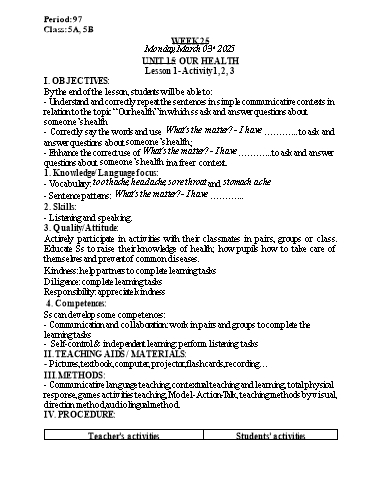
 Period: 97
Class: 5A, 5B
 WEEK 25
 Monday, March 03rd 2025
 UNIT 15: OUR HEALTH
 Lesson 1- Activity 1, 2, 3
I. OBJECTIVES:
By the end of the lesson, students will be able to:
- Understand and correctly repeat the sentences in simple communicative contexts in
relation to the topic “Our health” in which ss ask and answer questions about
someone’s health
- Correctly say the words and use What’s the matter? - I have ... to ask and
answer questions about someone’s health;
- Enhance the correct use of What’s the matter? - I have ... to ask and answer
questions about someone’s health in a freer context.
1. Knowledge/ Language focus:
- Vocabulary: toothache, headache, sore throat and stomach ache
- Sentence patterns: What’s the matter? - I have ...
2. Skills:
- Listening and speaking.
3. Quality /Attitude:
Actively participate in activities with their classmates in pairs, groups or class.
Educate Ss to raise their knowledge of health; how pupils how to take care of
themselves and prevent of common diseases.
Kindness: help partners to complete learning tasks
Diligence: complete learning tasks
Responsibility: appreciate kindness
 4. Competences:
Ss can develop some competences:
- Communication and collaboration: work in pairs and groups to complete the
learning tasks
- Self-control & independent learning: perform listening tasks
II. TEACHING AIDS / MATERIALS:
- Pictures, textbook, computer, projector, flashcards, recording
III. METHODS:
- Communicative language teaching, contextual teaching and learning, total physical
response, games activities teaching, Model-Action-Talk, teaching methods by visual,
direction method, audiolingual method.
IV. PROCEDURE:
 Teacher’s activities Students’ activities
 1.Warm- up: 5’
-Play game: Lucky balloons
*Aims: to help ss to happy to play game.
*Teaching techniques
- technique in teaching playing game
*Procedure:
- Tell Ss they are going to look at the -Ss listen.
picture, then ask and answer the question
about staying healthy or the frequency of an
activity.
- Divide the class into two groups.
- Have two Ss from each group choose a -Ss play game.
balloon in turn.
- Have them look at the pictures and ask and
answer the questions suitable with the
pictures.
 E.g. Student A: How does he stay healthy?
 Student B: He eats vegetables.
- If they ask and answer correctly, they get
corresponding points for their group.
- Continue playing the game with the other
pupils.
- The group that gets more points wins.
Praise the winner.
-Say “Open your book page 30 and look at -Ss open their book.
Unit 15, Lesson 1- Activity 1, 2, 3”
2. New lesson
Activity 1. -1. Look, listen and repeat:9’
*Aims: To understand and correctly repeat
the sentences in two communicative
contexts (pictures) in which ss ask and
answer questions about someone’s health
*Context:
- Context a:
Lucy’s mother: Are you OK, Lucy?
Lucy: I don’t feel well.
- Context b:
Lucy’s mother: What’s the matter?
Lucy: Ouch! I have a headache.
*Teaching techniques
- techniques in teaching listening and
speaking,
- individual, pairworks, ask and answer
 - using flashcards, recording, pictures
*Procedure:
-Set the scene: we are going to listen to the
dialogue in which the characters ask and -Look at the picture and listen.
answer questions about someone’s health
- Ask students to look at the picture in the -Ss look at the picture and identify
book and identify the characters in the the characters in the pictures.
pictures:
+ Who is he / she?
+ What are they talking about?
- Play the recording again for Ss to listen -Ss listen and repeat sentence by
and repeat in chorus, sentence by sentence. sentence.
-Divide the class into two groups to read the -Ss read in groups.
dialogue.
 -Ss point and read in pairs.
-Have time for ss to point and read in pairs.
T goes around the classroom to offer
support where necessary.
- Invite some pairs to practise in front of the -Ss practise in front of the class.
class.
- T get feedback.
*Outcome: Ss can understand and correctly
repeat the sentences in two communicative
contexts (pictures) in which ss ask and
answer questions about someone’s health
 Activity 2 - 2. Listen, point and say:9’
*Aims: to correctly say the words and use
What’s the matter? - I have ... to ask
and answer questions about someone’s
health
*Context: - Picture cues:
a. a boy with toothache
 b. a girl with a headache
c. a boy with a sore throat
d. a girl with a stomach ache
– Speech bubbles: What’s the matter? - I
have ...
*Teaching techniques
- techniques in teaching speaking,
pairworks, groupworks, ask and answer
- using flashcards, recording, pictures
*Procedure:
- Teach vocabulary: toothache, headache,
sore throat and stomach ache (Using -Ss listen and repeat new words, then
 write on their notebook.
pictures)
-Check vocabulary: slap the board -Ss play game.
- Have Ss look at pictures. Ask ss to look at -Look at the picture and answer.
Pictures a, b, c, and d and identify the
someone’s health of each character.
- Sentence Pattern:
What’s the matter? - I have ...
-Play the recording for Ss to listen to and -Ss listen and repeat.
repeat the words under the pictures in
chorus and individually until they feel
confident.
- T models with a student. Then asks Ss -A student model.
practice in pairs
- Have time for Ss to practise in pairs and -Ss practise in pairs.
corrects pronunciation if necessary.
- Invite ss to ask and answer in front of the -Ss practise in front of the class.
class.
- T gets feedback
*Outcome: Ss can correctly say the words
and use What’s the matter? - I have
 ... to ask and answer questions about
someone’s health
Activity 3. Let’s talk :7’
 *Aims: To enhance the correct use of
What’s the matter? - I have ... to ask
and answer questions about someone’s
health in a freer context.
*Context: Picture cue: A clinic at a primary
school where some pupils are waiting to
have their health problems checked by the
doctor.
– Speech bubbles: What’s the matter? - I
have ...
*Teaching techniques:
- techniques in teaching speaking,
groupworks, ask and answer
- using flashcards, pictures
*Procedure:
-Tell ss that they are going to practise more
 -Ss look and listen.
with their friends to ask and answer
questions about someone’s health in a freer
context.
- Elicit the words to fill in the gaps and have
ss to repeat. -Ss repeat.
-Have time for ss to practise in pairs. Go
around the classroom to offer support where -Ss practise in pairs.
necessary.
-Call some pairs to act out in front of the
class. -Ss act out in front of the class.
- T corrects pronunciation, if necessary.
-T gets feedback.
*Outcome: Ss can enhance the correct use
of What’s the matter? - I have ... to
ask and answer questions about someone’s
health in a freer context.
3. Consolidation :3’
*Aims: to consolidate and wrap up the
content of the lesson.
 - T tells Ss about the main content of the
 lesson.
 - T tells Ss about the educational aims of the
 lesson. -Ss listen.
 4. Homelink. 1’
 - Practice more at home.
 - Prepare for the next lesson.
 -Ss listen.
 ***********************************
Period: 98
Class: 5A, 5B
 Tuesday, March 04th 2025
 UNIT 15: OUR HEALTH
 Lesson 1- Activity 4, 5, 6
I. OBJECTIVES:
By the end of the lesson, students will be able to:
- Listen to and understand four communicative contexts in which characters ask and
answer questions about someone’s health problems, and number the picture in the
order.
- Complete four gapped exchanges with the help of picture cues.
- Sing the song What’s the matter? with the correct pronunciation and melody.
1. Knowledge/ Language focus:
- Vocabulary: review
- Sentence patterns: review
2. Skills:
- Listening, writing and reading
3. Quality /Attitude:
Actively participate in activities with their classmates in pairs, groups or class.
Educate Ss to raise their knowledge of health; show Ss how to take care of
themselves and prevent common diseases.
 Kindness: help partners to complete learning tasks
 Diligence: complete learning tasks
 Responsibility: appreciate kindness
Leadership: collaborate with teachers to enhance language skills
4. Competences:
SS can develop some competences:
- Communication and collaboration: work in pairs and groups to complete the
learning tasks
- Self-control & independent learning: perform listening tasks
 II. TEACHING AIDS / MATERIALS:
- Pictures, textbook, computer, projector, flashcards, flashcards, recording
III. METHODS:
- Communicative language teaching, contextual teaching and learning, total physical
response, games activities teaching, Model-Action-Talk, teaching methods by visual,
direction method, audiolingual method.
IV. PROCEDURE:
 Teacher’s activities Students’ activities
 1.Warm- up: 5’
 Play game: Game: “Yes or No”
 *Aims: to help ss to review some words and
 sentence pattern about someone’s health
 *Teaching techniques
 - techniques in teaching playing game
 *Procedure:
 - Tell the class how to play the game. Ask - Ss listen
 Ss to play the game individually.
 - Prepare Yes and No boards for Ss.
 - Show a picture and a sentence on the -Ss play game.
 board. Have pupils look at the picture and
 the sentence.
 - Ask Ss to raise the Yes board if the picture
 and sentence are matched.
 - Ask Ss to raise the No board if the picture
 and sentence are not matched. Have Ss say
 the correct sentence aloud.
 e.g.(picture of a boy with toothache) - I
 have a toothache.
 The class raise the Yes board.
 e.g.(picture of a girl with a sore throat) - I
 have a stomach ache.
 The class raise the No board.
 - Give stickers to the fastest student with the
 correct answer.
 -Say “Open your book page 31 and look at -Ss open their book.
 lesson 3 – Activity 4, 5, 6”
 2. New lesson
 Activity 1. - 4. Listen and number:9’
 *Aims: to listen, understand and number
 the correct pictures relevant to two
 communicative contexts in which two Ss
 ask and answer about someone’s health
 *Context:
Picture cues:
a. a boy with a sore throat
b. a boy with a stomach ache
c. a boy with a headache
d. a boy with toothache
*Audio script:
1. Girl: You look tired today. What’s the
matter?
Boy: I have a stomach ache.
2. Girl: You don’t look well today. What’s
the matter?
 Boy: I have a headache.
3. Girl: You’re very quiet today. What’s the
matter?
Boy: I have a sore throat.
4. Girl: You’re eating slowly. What’s the
matter?
 Boy: I have a toothache.
*Teaching techniques
- techniques in teaching listening
-individual, pairworks, using recording,
pictures
*Procedure:
-Aks ss to look at the pitures and identify
personal information of the character in -Look at the picture, listen and
 answer.
each picture. Point at the pictures
respectively to explain the context.
- Play the recording for ss to do the task. Go
around the classroom to offer support if -Ss listen and do the task.
necessary.
- Get Ss to swap with a partner.
 -Ss swap.
- Play the recording again to check answers
 -Ss listen and repeat.
together as a class.
-Ask ss to write their answers on the board
and correct their answers. -Ss write their answers
 - Play the recording all the way through for
Ss to double-check all the answers. -Ss check the answers.
*Key: a. 3, b. 1, c. 2, d .4
*Outcome: Ss can listen, understand and
number the correct pictures relevant to two
communicative contexts in which two Ss
ask and answer about someone’s health
 Activity 2 - 5. Read and complete:9’
*Aims:to complete the target sentence
patterns about health problems with the help
of picture cues.
*Context:Four picture cues showing
different health problems, some sentences
and exchanges with the target sentences to
complete
*Teaching techniques
- techniques in teaching reading
-individual, pairworks, pictures
*Procedure:
- Get Ss to look at the pictures. Get them to -Look at the picture and identify.
identify someone’s health of the character
in each picture.
- Have Ss look at the four incomplete
sentences and guess the missing word. Ask -Ss look and listen.
them what is missing in the answer. Have
them look at the picture and identify the
needed missing word (headache).
- Model with a sentence.
- Have Ss complete the sentences
individually. Go around the classroom to -Ss do the task.
offer support where necessary.
-Ask ss to write their answers on the board
 -Ss write their answers.
and correct their answers.
 -Ask a few Ss to read the correct answers in
front of the class. -Ss read in front of the class.
-T gets feedback.
* Key: 1. headache 2. toothache
3. the matter; sore throat
4. What’s; have a stomach ache
*Outcome: Ss can complete the target
sentence patterns about health problems
with the help of picture cues.
Activity 3. - 6. Let’s sing :7’
*Aims: to sing the song What’s the matter?
with the correct pronunciation and melody.
*Teaching techniques
- techniques in teaching singing the song
- individual, groupworks, using recording,
pictures
*Procedure:
-Draw student’s attention to the title and
lyrics of the song. Check comprehension of -Ss look and listen.
the lyrics and give feedback.
- Play the recording all the way through for -Ss listen and pay attention to the
Ss to listen to the whole song again. Tell pronunciation and melody.
them to pay attention to the pronunciation
and melody.
- Play the recording line by line for Ss to -Ss listen and repeat line by line.
listen, repeat and point at the relevant
character. Correct their pronunciation where
necessary.
- Give Ss time to practice singing and doing -Ss practise singing and doing
actions in pairs actions in pairs.
 - Invite some groups to perform in front of
 the class and the rest of the class claps along -Ss perform in front of the class.
 the song.
 *Outcome: Ss can sing the song What’s the
 matter? with the correct pronunciation and
 melody.
 3. Consolidation :3’
 *Aims: to consolidate and wrap up the
 content of the lesson.
 - T tells Ss about the main content of the
 lesson. -Ss listen.
 - T tells Ss about the educational aims of the
 lesson.
 4. Homelink .2’
 - Practice more at home. -Ss listen.
 - Prepare for the next lesson.
 ***********************************
Period: 99
Class: 5A, 5B
 Wednesday, March 05th 2025
 UNIT 15: OUR HEALTH
 Lesson 2- Activity 1, 2, 3
I. OBJECTIVES:
By the end of the lesson, students will be able to:
- Understand and correctly repeat the sentences in simple communicative contexts in
relation to the topic “Our health” in which Ss advise and respond to advice about
health problems.
- Correctly say the words and use You should -Thanks for your advice. to
advise and respond to advice about health problems;
- Enhance the correct use of You should -Thanks for your advice. to
advise and respond to advice about health problems in a freer context.
1. Knowledge/ Language focus:
- Vocabulary: go to the dentist, have a rest, drink warm water and take some
medicine
- Sentence patterns: You should -Thanks for your advice.
2. Skills:speaking.
3. Quality /Attitude:
 Actively participate in activities with their classmates in pairs, groups or class.
Educate Ss to raise their knowledge of health; show Ss how to give advice about
health problems.
Kindness: help partners to complete learning tasks
Diligence: complete learning tasks
Responsibility: appreciate kindness
 4. Competences:
Ss can develop some competences:
- Communication and collaboration: work in pairs and groups to complete the
learning tasks
- Self-control & independent learning: perform listening tasks
II. TEACHING AIDS / MATERIALS:
- Pictures, textbook, computer, projector, flashcards, recording
III. METHODS:
- Communicative language teaching, contextual teaching and learning, total physical
response, games activities teaching, Model-Action-Talk, teaching methods by visual,
direction method, audiolingual method.
IV. PROCEDURE:
 Teacher’s activities Students’ activities
 1.Warm- up: 5’
 Game: “Pass the bag”
 *Aims: to help ss to be happy to learn new
 lesson.
 *Teaching techniques
 - techniques in teaching playing game.
 *Procedure:
 - Explain that Ss are going to look at the -Ss look and listen.
 picture and say the sentence about health.
 Put some flashcards (toothache, headache,
 sore throat, stomach ache) in a bag.
 - Have Ss make two circles. - Ss play game.
 - Ask Ss to pass the bag around the circle
 while music plays.
 - When the music stops, ask the student
 holding the bag to take out a flashcard in
 the bag and say a sentence, e.g. I have a
 stomach ache.
 - Praise Ss to encourage their performance.
 -Say “Open your book page 32 and look at -Ss open their book.
 Unit 15, Lesson 2 – Activity 1, 2, 3”
 2. New lesson
 Activity 1. -1. Look, listen and repeat:9’
*Aims: To understand and correctly repeat
the sentences in two communicative
contexts focusing on advising and
responding to advice about health
problems
*Context:
- Context a:
Mary: How are you today, Nam?
Nam: I don’t feel very well. I have a
toothache.
- Context b:
Mary: You should go to the dentist, Nam.
You should go as soon as possible.
Nam: Okay, I will. Thanks for your advice.
*Teaching techniques:
- techniques in teaching listening and
speaking,
- individual, pairworks, ask and answer
- using flashcards, recording, pictures
*Procedure:
-Set the scene: we are going to listen to the
 -Look at the picture and listen.
dialogue in which the characters advise
and respond to advice about health
problems.
- Ask students to look at the picture in the
book and identify the characters in the -Ss look at the picture and identify
pictures: the characters in the pictures.
+Who are they in the picture?
+What are they talking about?
- Play the recording again for Ss to listen
 -Ss listen and repeat sentence by
and repeat in chorus, sentence by sentence.
 sentence.
-Divide the class into two groups to read
 -Ss read in groups.
the dialogue.
-Have time for Ss to point and read in -Ss point and read in pairs.
 pairs. T goes around the classroom to offer
support where necessary.
- Invite some pairs to practise in front of -Ss practise in front of the class.
the class.
- T get feedback.
*Outcome: Ss can understand and
correctly repeat the sentences in two
communicative contexts focusing on
advising and responding to advice about
health problems
 Activity 2 - 2. Listen, point and say:10’
*Aims: to correctly say the words and use
You should -Thanks for your
advice. to advise and respond to advice
about health problems.
*Context:
- Picture cues:
a. a dentist checking her patient’s teeth
b. a girl having a rest
c. a cup of warm water
d. some medicine
- Speech bubbles:You should
 ->Thanks for your advice.
*Teaching techniques
- techniques in teaching speaking,
pairworks, ask and answer
- using flashcards, recording, pictures
*Procedure:
- Teach vocabulary:go to the dentist, have
a rest, drink warm water and take some -Ss listen and repeat new words, then
medicine (Using pictures) write on their notebook
-Check vocabulary: game slap the board
- Have Ss look at pictures. Ask them to -Ss play game.
identify the advice of health problems in -Look at the picture and answer.
the pictures.
- Sentence Pattern:
+ You should -Thanks for your
advice.
 -T models with a student. Then asks ss -A student model.
practise in pairs.
-Divide the class into two groups to read -Ss read in groups.
the dialogue.
- Have time for Ss to practise in pairs and -Ss practise in pairs.
corrects pronunciation if necessary.
- Invite ss to ask and answer in front of the -Ss practise in front of the class.
class. (Play game: Who is faster?).
- T gets feedback
*Outcome: Ss can correctly say the words
and use You should -Thanks for
your advice. to advise and respond to
advice about health problems
Activity 3. Let’s talk :6’
*Aims: To enhance the correct use You
should -Thanks for your advice.
to advise and respond to advice about
health problems in a freer context.
*Context: Picture cues: a group of
characters with some health problems
– Speech bubbles: You should
 ->Thanks for your advice.
*Teaching techniques
- techniques in teaching speaking,
groupworks, ask and answer
- using flashcards, pictures
*Procedure:
-Tell ss that they are going to practise
more with their friends to advise and -Ss look and listen.
respond to advice about health problems in
a freer context.
 - Elicit the words to fill in the gaps and
 have ss to repeat.
 -Have time for ss to practise in pairs. Go -Ss repeat.
 around the classroom to offer support
 where necessary. -Ss practise in pairs.
 -Call some pairs to act out in front of the
 class.
 -Ss act out in front of the class.
 - T corrects pronunciation, if necessary.
 -T gets feedback.
 *Outcome: Ss can enhance the correct use
 You should -Thanks for your
 advice. to advise and respond to advice
 about health problems in a freer context.
 3. Consolidation :3’
 *Aims: to consolidate and wrap up the
 content of the lesson.
 - T tells Ss about the main content of the
 lesson.
 - T tells Ss about the educational aims of
 the lessons.
 4. Homelink. 1’
 - Practice more at home. -Ss listen.
 - Prepare for the next lesson. -Ss listen.
 ***********************************
Period: 100
Class: 5A, 5B
 Thursday, March 06h 2025
 UNIT 15: OUR HEALTH
 Lesson 2 - Activity 4, 5, 6
I. OBJECTIVES:
 By the end of the lesson, students will be able to:
- Listen to and understand the communicative contexts in which characters talk
about health problems in the correct pictures.
- Complete the target sentence patterns in two conversations about health problems
and advice for them with the help of picture cues.
- Role-play by asking and giving advice about health problems
1. Knowledge/ Language focus:
- Vocabulary: review
- Sentence patterns: review
2. Skills:
- Listening, reading and speaking
3. Quality /Attitude:
-Actively participate in activities with their classmates in pairs, groups or class.
Educate Ss to raise their knowledge of health, show Ss how to give advice about
health problems.
 Kindness: help partners to complete learning tasks
 Diligence: complete learning tasks
Leadership: collaborate with teachers to enhance language skills
4. Competences:
Ss can develop some competences:
- Communication and collaboration: work in pairs and groups to complete the
learning tasks
- Self-control & independent learning: perform listening tasks
II. TEACHING AIDS / MATERIALS:
- Pictures, textbook, computer, projector, flashcards, recording
III. METHODS:
- Communicative language teaching, contextual teaching and learning, total physical
response, games activities teaching, Model-Action-Talk, teaching methods by visual,
direction method, audiolingual method.
IV. PROCEDURE:
 Teacher’s activities Students’ activities
 1.Warm- up: 5’
 Game: “Questions and answers”
 *Aims: to help ss to be happy and play
 game
 *Teaching techniques:
 - techniques in teaching playing game
 *Procedure:
 - Tell Ss how the game is played. Give an - Ss listen.
 example.
 - Put Ss into pairs. -Ss play game.
 - Encourage the Ss to play rock, paper,
scissors. The loser gives advice. The
winner replies for the advice.
E.g. Student A: You should drink warm
water.
 Student B: Thanks for your advice.
- Praise Ss to encourage their performance.
 -Ss open their book.
-Say “Open your book page 33 and look at
lesson 2 – Activity 4, 5, 6”
2. New lesson
Activity 1. - 4. Listen and tick :9’
*Aims: to listen to and understand two
communicative contexts in which Ss
advise and respond to advice about health
problems and tick the correct pictures.
*Context:
*Picture cues:
1. a. Nam with a headache and Nam
having a rest in a bed
b. Nam with a headache and Nam
watching TV
c. Nam with toothache and Nam having a
rest in a bed
2. a. Lucy with toothache and Lucy taking
some medicine
b. Lucy with toothache and Lucy having
her teeth checked by the dentist
c. Lucy with a headache and Lucy taking
some medicine
*Audio script:
1.Girl: You don’t look well. What’s the
matter, Nam?
Boy: I have a headache.
Girl: Don’t watch lots of TV. You should
have a rest.
Boy: Okay, I will. Thanks for your advice.
2.Boy: You look tired. What’s the matter
with you?
Girl: I have a toothache. It hurts.
Boy: You should go to the dentist.
Girl: That’s a good idea. Thanks for your
advice.
*Teaching techniques
 - techniques in teaching listening
-individual, pairworks, using recording,
pictures
*Procedure:
-Draw student’s attention to the sentences
1and 2, 3. Tell them about the activity. -Look at the picture, listen and
Elicit advising and responding to advice answer.
about health problems in each picture.
Point at the pictures respectively to explain
the context.
- Play the recording for ss to do the task.
 -Ss listen and do the task
- Get Ss to swap with a partner.
 -Ss swap.
-Play the recording again to check answers -Ss listen and repeat.
together as a class.
-Ask ss to write their answers on the board -Ss write their answers
and correct their answers.
- T gets feedback.
* Key: 1. a 2. b
*Outcome: Ss can listen to and understand
two communicative contexts in which Ss
ask and answer questions about advising
and responding to advice about health
problems and tick the correct pictures.
Activity 2 - 5. Read and complete:9’
*Aims: to complete two target gapped
exchanges with the help of picture cues.
*Context: two picture cues of health
problems and two conversations with gaps
to complete
*Teaching techniques
- techniques in teaching reading
-individual, pairworks, pictures
*Procedure:
- Ask Ss to look at the pictures and -Look at the picture and identify.
identify the health problems that the
 characters have.
- Have Ss read sentence 1. Ask them what
is missing from the gaps. Have them
complete the gaps by finding the clues
from the context and the picture. Repeat
the same procedure with sentence 2.
- Model with a sentence.
- Have Ss complete the sentences
individually. Go around the classroom to
offer support where necessary. -Ss do the task.
-Ask ss to write their answers on the board
and correct their answers. -Ss write their answers
-Ask a few Ss to read the correct answers
 -Ss read in front of the class.
in front of the class.
-T gets feedback.
 * Key:
1. the matter; a headache; some medicine
2. toothache; should go to the dentist
*Outcome: Ss can complete two target
gapped exchanges with the help of picture
cues.
Activity 3. - 6. Let’s play :7’
*Aims: to role-play by asking and giving
advice about health problems
*Context: Picture cues: Mai and Nam are
role-playing as a doctor and a patient
*Teaching techniques
- techniques in playing game
- individual, groupworks, using recording,
pictures
*Procedure:
- Tell Ss to role- play in pairs as a doctor
and a patient within 3 minutes. Encourage
them to ask and give advice about health -Ss look and listen.
problems. Go round the class and give
support when necessary.
File đính kèm:
- ke_hoach_bai_day_tieng_anh_lop_5_global_success_tuan_25_nam.docx

